How Microorganisms Influence Drug Activity and Biological Responses
An accessible scientific overview of how microorganisms can transform drugs, influence drug activity, affect biological responses, and shape modern pharmacological research.
When microbes change medicine.
A drug does not enter an empty biological system. Microorganisms can transform compounds, produce metabolites, alter exposure, and influence the biological response that follows.
Pharmacology traditionally asks what a drug does to the body and what the body does to the drug. Microbiology introduces another question: what happens when microorganisms encounter that molecule?
The answer can involve microbial enzymes, chemical transformation, transport, accumulation, metabolite production, and interactions with host physiology. These mechanisms form the basis of pharmacomicrobiomics.
Why Microorganisms Matter in Pharmacology
A therapeutic compound is exposed to many biological environments during its journey through the body. These include the intestinal lumen, epithelial surfaces, blood, tissues, and organs.
The intestinal environment is particularly interesting because it contains a dense and metabolically active microbial ecosystem.
Microorganisms can therefore become an additional biological variable influencing drug disposition and response.
The microbiome can influence drug pharmacokinetics and pharmacodynamics through direct chemical transformation, bioaccumulation, and indirect effects on host metabolic and immune systems. :contentReference[oaicite:1]{index=1}
How Microorganisms Transform Chemical Compounds
Microbial cells contain enzymes capable of recognizing and modifying chemically diverse molecules. Some of these reactions can change the structure of a drug before it reaches systemic circulation.
Gut microorganisms frequently use biochemical reactions such as hydrolysis and reduction, while host metabolism involves a different collection of enzymatic pathways.
Microbial enzymes
Can chemically modify compounds within the intestinal microbial environment.
Host enzymes
Transform compounds through metabolic pathways distributed across tissues and organs.
These two metabolic systems can interact, meaning that the final biological exposure to a compound may reflect both host and microbial activity.
Microbial Enzymes and Drug Metabolism
The most direct connection between microbiology and pharmacology occurs when a microbial enzyme chemically transforms a drug.
Identifying the responsible enzyme can transform an observational finding into a mechanistic explanation.
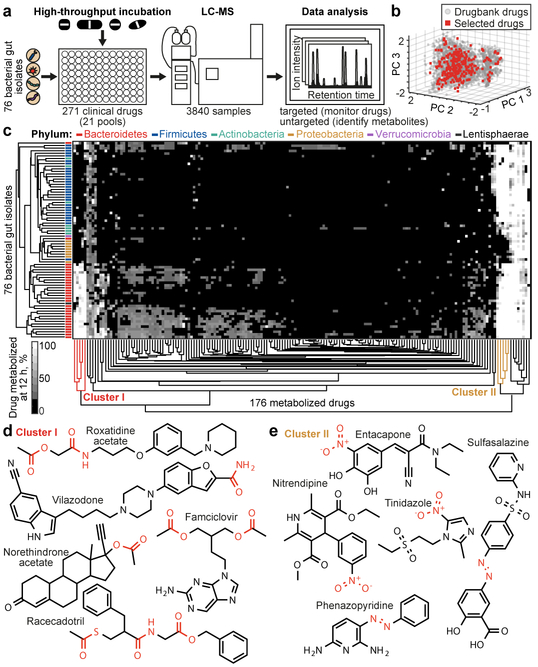
Source: Nature — Mapping human microbiome drug metabolism by gut bacteria and their genes
In a large-scale study, researchers tested hundreds of compounds against human gut bacterial strains and identified extensive bacteria–drug metabolic interactions. :contentReference[oaicite:2]{index=2}
When Microbial Metabolism Changes Drug Activity
Chemical transformation does not necessarily mean that a drug simply disappears. The resulting molecule may behave differently from the original compound.
The important point is that microbial metabolism can change the chemical identity of what ultimately reaches host tissues.
The Gut Microbiome as a Biological Environment
The gut is not simply a container holding microorganisms. It is a dynamic biochemical environment containing nutrients, metabolites, host secretions, microbial products, and therapeutic compounds.
The composition and functional activity of the microbial community can therefore influence the chemical environment encountered by a drug.
Drug behaviour can be considered as the result of an interaction between the molecule, microbial community, host metabolism, and biological environment.
How Scientists Detect Drug–Microorganism Interactions
A modern pharmacomicrobiomics experiment rarely depends on a single analytical technique. Researchers combine several measurement layers to move from microbial composition toward molecular mechanism.
| Layer | Technology | Question |
|---|---|---|
| Community | 16S / metagenomics | Which microorganisms and genes are present? |
| Chemistry | LC–MS / metabolomics | Which compounds and metabolites are changing? |
| Function | Enzyme assays | Which biochemical activity causes the transformation? |
| Mechanism | Genetics | Which microbial gene is responsible? |
From Microbial Data to Biological Meaning
Detecting an association is not the same as proving a mechanism. A microbial species may correlate with a drug response without being directly responsible for that response.
Strong mechanistic research therefore connects several levels of evidence.
This progression turns large datasets into experimentally testable biological hypotheses.
Why the Same Drug Can Behave Differently Between Individuals
Individuals differ in their microbial communities. They can carry different organisms, different microbial genes, and different levels of metabolic activity.
This variation provides one possible explanation for part of the inter-individual variability observed in drug response.
Microbial profile A
Different microbial enzymes and metabolic pathways may produce one pattern of drug transformation.
Microbial profile B
A different microbial functional profile may produce another pattern of exposure or metabolite formation.
This is one of the reasons pharmacomicrobiomics has become relevant to precision medicine research. :contentReference[oaicite:3]{index=3}
From Microbial Mechanisms to Biotechnology
Understanding microbial drug metabolism can have practical value beyond describing biological interactions.
Identified microbial enzymes can become experimental targets. Microbial signatures may become biomarkers. Metabolic pathways can inform drug development and screening strategies.
The Future of Pharmacomicrobiomics
The next challenge is no longer simply to identify microorganisms associated with drug response. Researchers increasingly need to determine which genes, enzymes, pathways, and metabolites actually drive the interaction.
This requires integration of microbiology, molecular biology, pharmacology, analytical chemistry, sequencing, metabolomics, and computational biology.
Microbe → Gene → Enzyme → Drug → Metabolite → Host → Response
The result is a shift from simply asking which microorganisms are present toward asking what they are capable of doing and how their activities influence biological systems.
Selected Research
Mapping human microbiome drug metabolism by gut bacteria and their genes Principles and Terminology for Host–Microbiome–Drug Interactions Precision medicine goes microscopic: engineering the microbiome to improve drug outcomes Pharmacomicrobiomics: a novel route towards personalized medicine?The drug is only one part of the biological equation.
Microorganisms add another layer of metabolism, chemistry, and biological variability. By studying microbial genes, enzymes, metabolites, and interactions with host systems, researchers can better understand why drug behaviour can vary across biological environments and individuals.
Pharmacomicrobiomics therefore represents more than a connection between pharmacology and microbiology. It is a systems-level approach to understanding how biological communities participate in the fate of therapeutic molecules.